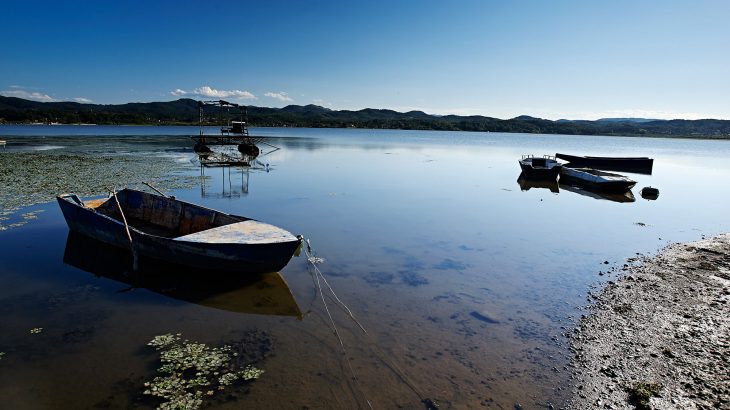
The area surrounding the Modrac reservoir is rich in forests and forest land, which occupy a significant portion of the total territory. Forests and forest land cover approximately 2,624 hectares, representing about one-third of the spatial plan area. Of this total, 41.8% is state-owned and 58.2% privately owned. This ownership structure highlights the important role that local communities play in the management and preservation of forest resources.
Several forest types are present within this area. The most common are coppice forests, which cover around 1,338 hectares. These forests are formed through natural regeneration after logging, consisting mainly of young shoots sprouting from the stumps of previously cut trees. Although coppice forests have lower ecological stability compared to high forests, they are important for soil protection and contribute to landscape diversity. In addition to these, there are also high forests covering more than 700 hectares, both under state and private ownership. High forests develop naturally from seeds and are of greater ecological and economic value. Furthermore, the spatial plan records the presence of forest plantations, clearings, and mixed-use parcels.
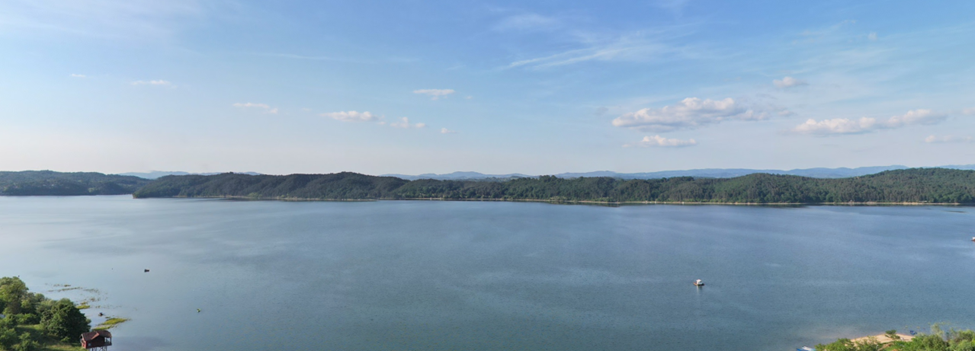
From a vegetation standpoint, the area around the lake belongs to the climazonal belt of sessile oak and common hornbeam. On the northern shore of the reservoir, in the section stretching from the dam toward Kiseljak, the typical forest community of sessile oak and common hornbeam (Querco-Carpinetum illiricum) is well preserved. This community represents a natural forest zone that has developed in harmony with the prevailing climatic and soil conditions. In the higher areas, on the slopes of Mount Majevica, beech forests dominate, while in certain parts black pine and Scots pine forests (Pinetum nigrae-silvestris) are also present.
In the valley of the Spreča River and its tributaries, riparian forests of black alder (Alnus glutinosa), white willow (Salix alba), and narrow-leaved ash (Fraxinus oxycarpa) are found. These forests are of particular importance as they grow on moist terrain and form green belts along riverbanks. Their ecological role is multifaceted — they protect riverbanks from erosion, enrich the soil with organic matter, and provide essential habitats for a variety of animal species.
In addition to forests, an important part of the vegetation consists of wetland habitats that develop in the shallow coastal zones of the reservoir. These areas are dominated by common reed (Phragmites communis), tall sedges, and cattails (Typha sp.). This hydrophilic vegetation plays a vital ecological role as a natural water filter, reducing pollution and contributing to the overall stability of the aquatic ecosystem. The wetland zones also serve as habitats for numerous fish, amphibians, and bird species, making them an indispensable part of the Modrac ecosystem.